The AI Apps Opportunity
November 5, 2025
On October 6th, at OpenAI’s Dev Day, OpenAI announced Apps inside ChatGPT. Here’s a quick overview of what that means:
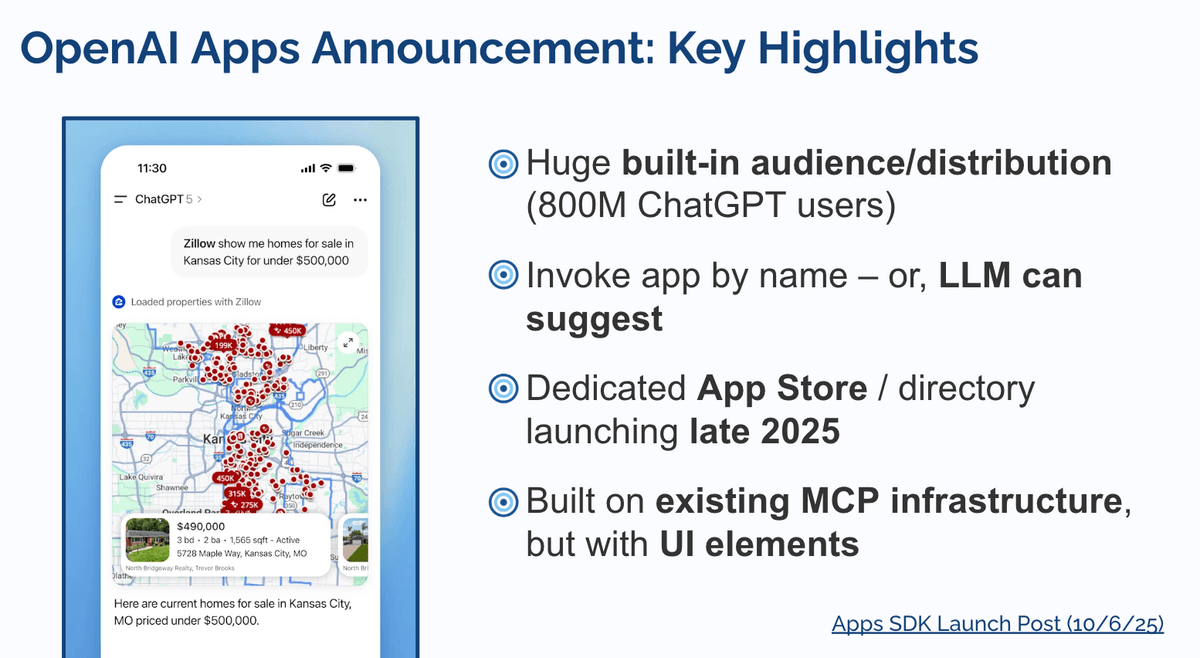
ChatGPT App Experience Walkthrough
Let’s look at how this works in practice! This is live today for all U.S. users, so you can also try it out yourself.
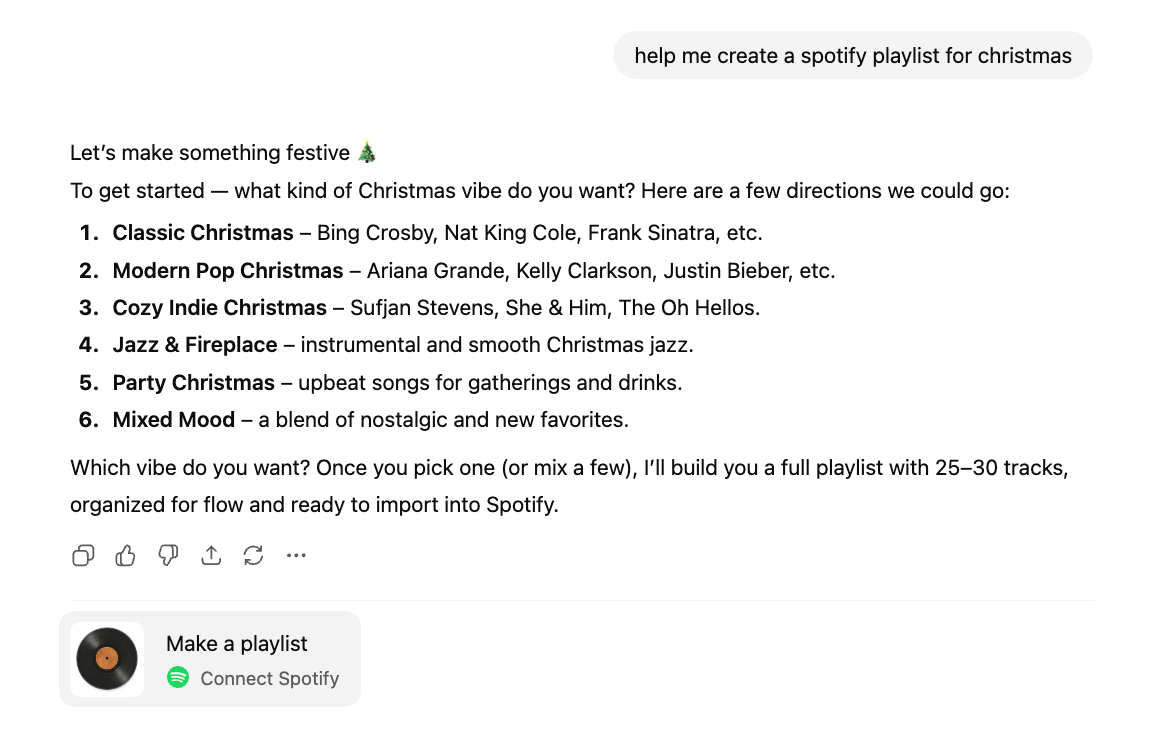
Before you even enable any Apps, ChatGPT will proactively suggest them to you if they’re relevant to your use case.
This can also happen even if you don’t ask for the company by name; when I asked for cheap flights to Chile, ChatGPT suggested Expedia:
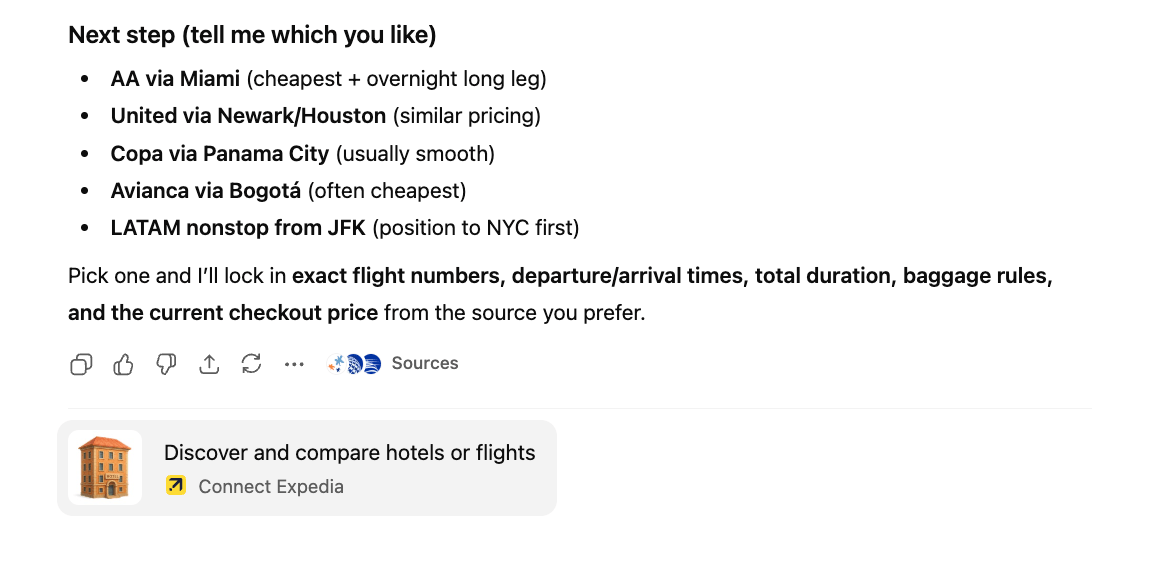
This opens up a new opportunity for top-of-funnel discovery, and it’s not hard to imagine how ads or paid placement might soon be part of this flow.
Once you select an App, you are prompted to enable or ‘link’ it, either by logging in with ChatGPT or with the provider on their site:
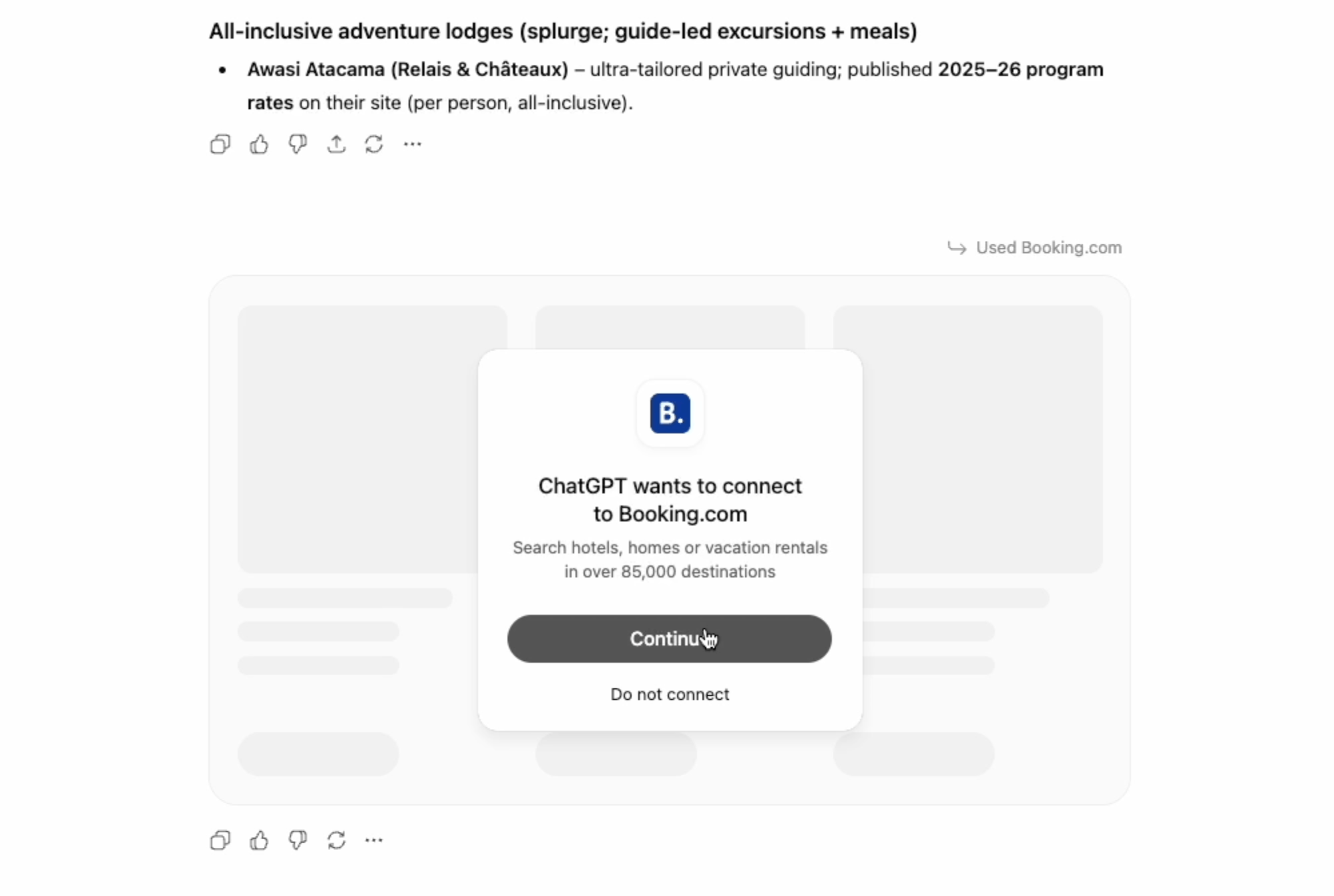
After that, even if you don’t specify which App you want to use, ChatGPT can use your existing linked Apps to answer relevant questions, like activating the Booking.com App to find hotels. App results can include pictures, maps, buttons, and more:
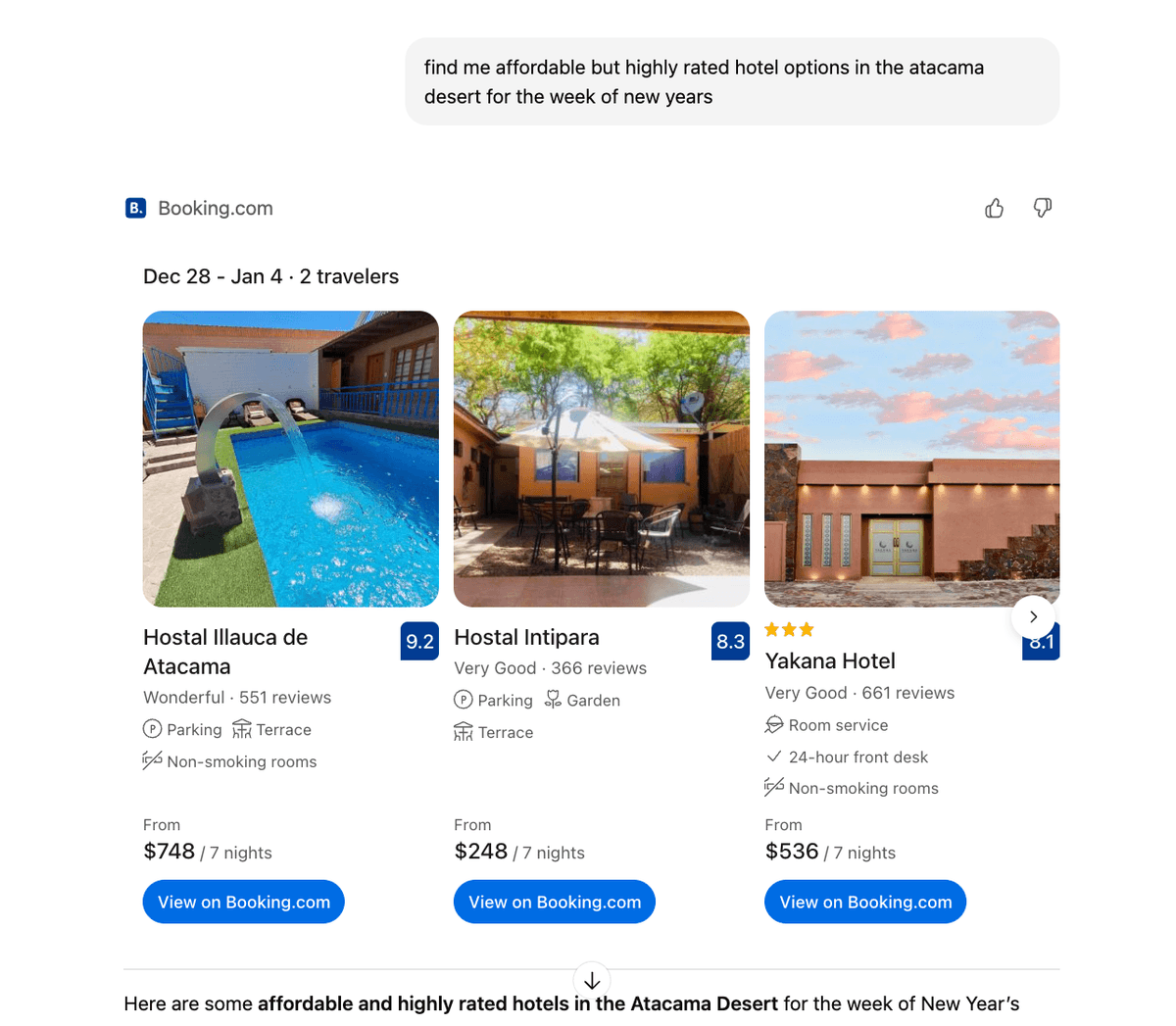
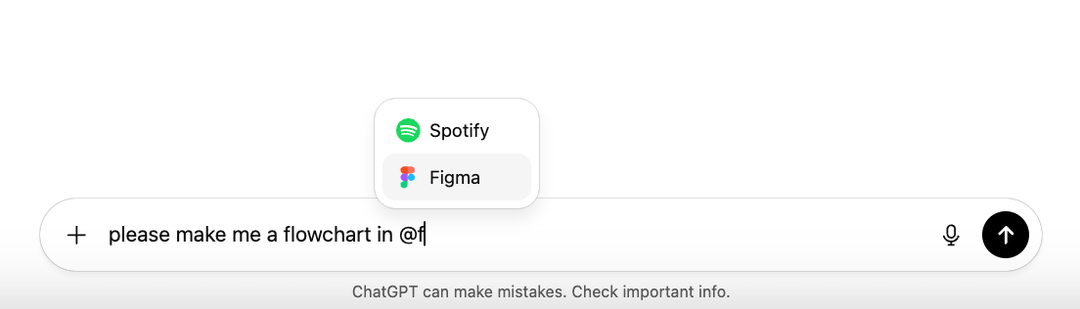
Or, if you have a specific App you know you want to use, you can also ‘tag’ to request it by name.
ChatGPT Apps: Old Technology, New Focus & Distribution
While this might seem revolutionary, it’s actually an incremental step building on existing technology developed and refined over the past year: MCP (Model Context Protocol) servers.
MCP servers are essentially plug-ins that let AI tools access and work with data from third parties (think Google Calendar, Figma, Outlook). They’ve been available for months in ChatGPT, Claude, and other tools under the “Connectors” branding.
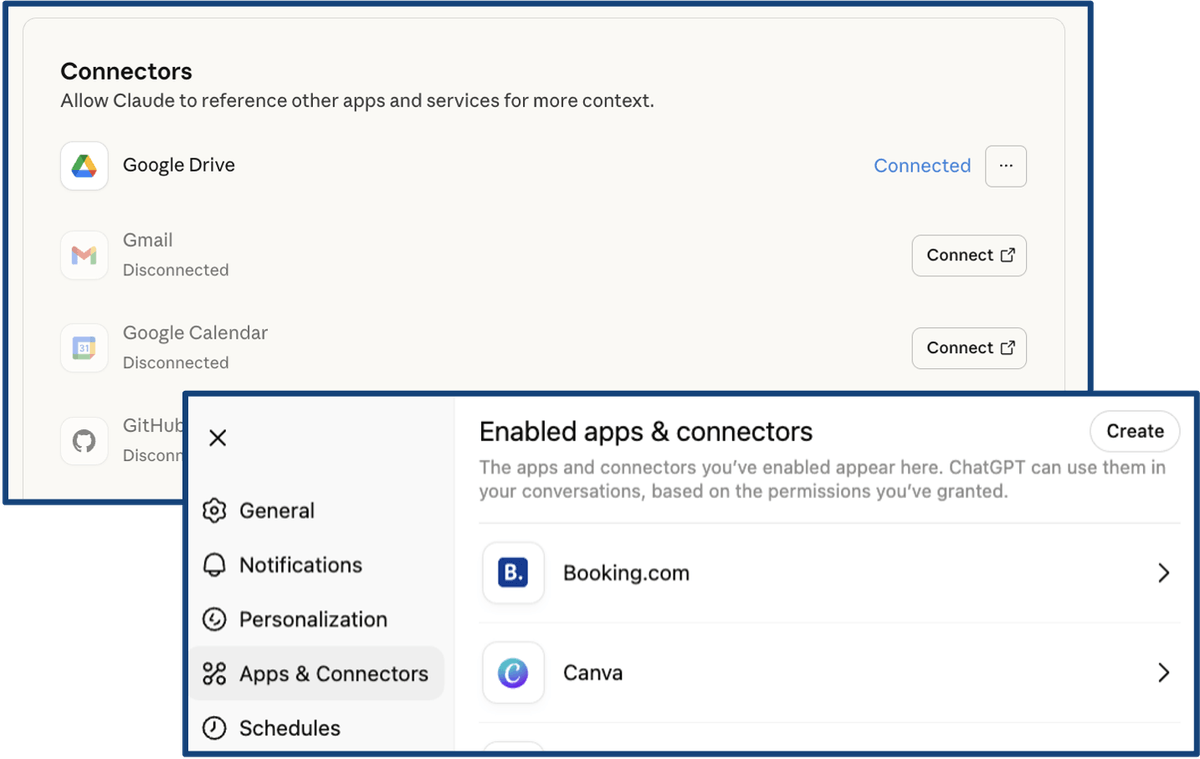
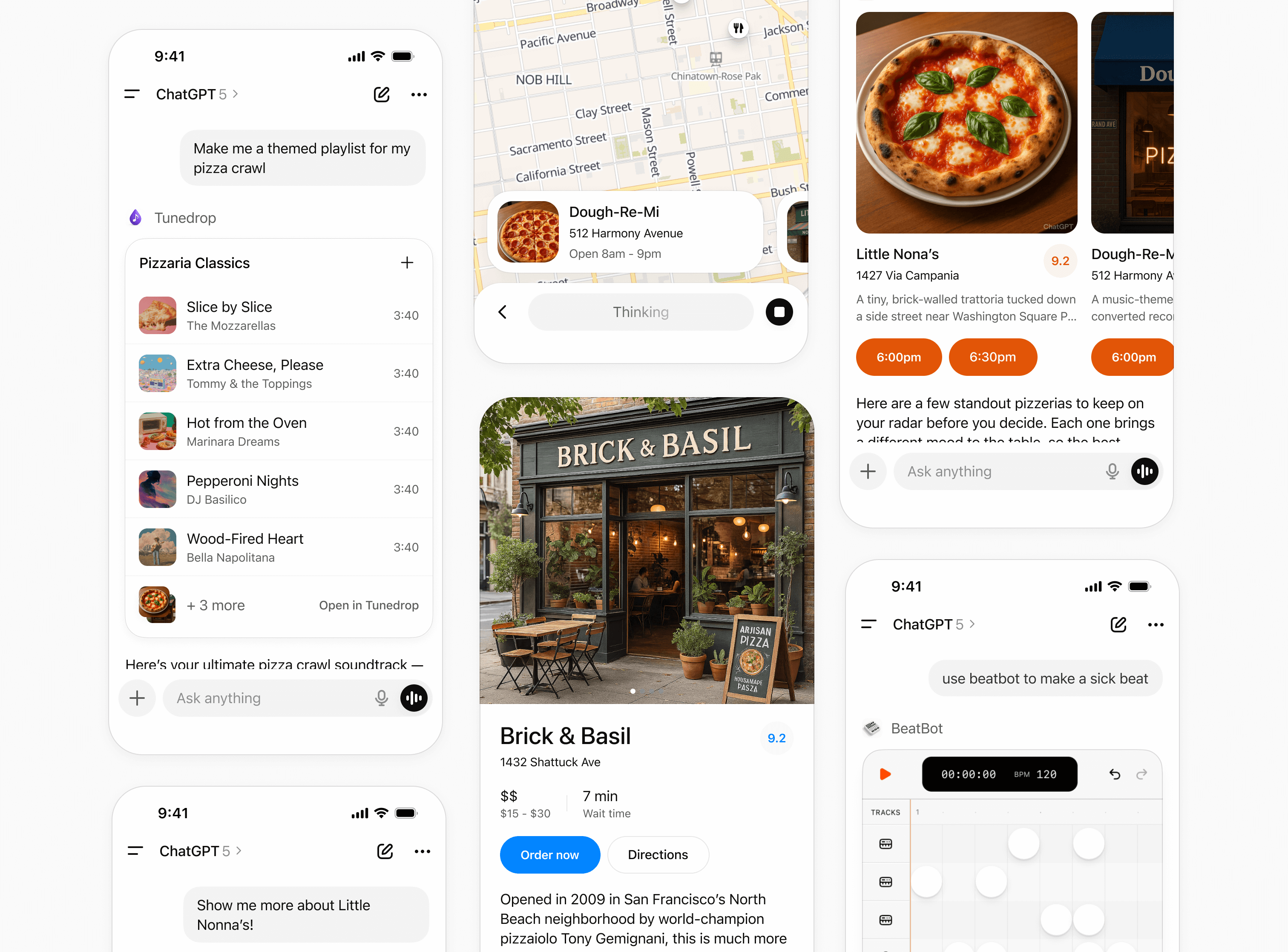
Apps take Connectors a step further by adding a user interface to those tools.
Now, instead of just data and plain text, third-party apps can display images, maps, and even checkout buttons directly inside ChatGPT. The technology isn’t new, but the framing is: this looks less like a data plug-in and more like a powerful new distribution surface.
Here’s what Ben Thompson, the author of Stratechery, had to say about the launch in his post “OpenAI’s Windows Play”, bolding mine:
In other words, the best-case outcome for Apps-in-AI could rival early Windows, the web, or mobile apps: AI chatbots could become the new operating systems that apps are built on—with all the opportunity that entails.
Sizing the Opportunity
OpenAI, leading the charge, has 800 million active users, and a retention graph that curves upward: users use ChatGPT more over time, not less.
By comparison, Apple’s App Store, which launched in 2008, has 813 million weekly active users, and drives 1.3 trillion of annual sales.
OpenAI plans to launch its own App Store later this year, giving developers a place to list ChatGPT Apps. If this really is the new operating system, that’s a trillion-dollar opportunity, and a new ecosystem of tools will emerge around it.
And while not everyone is on board, ChatGPT has a long list of prominent launch partners to start the momentum going:
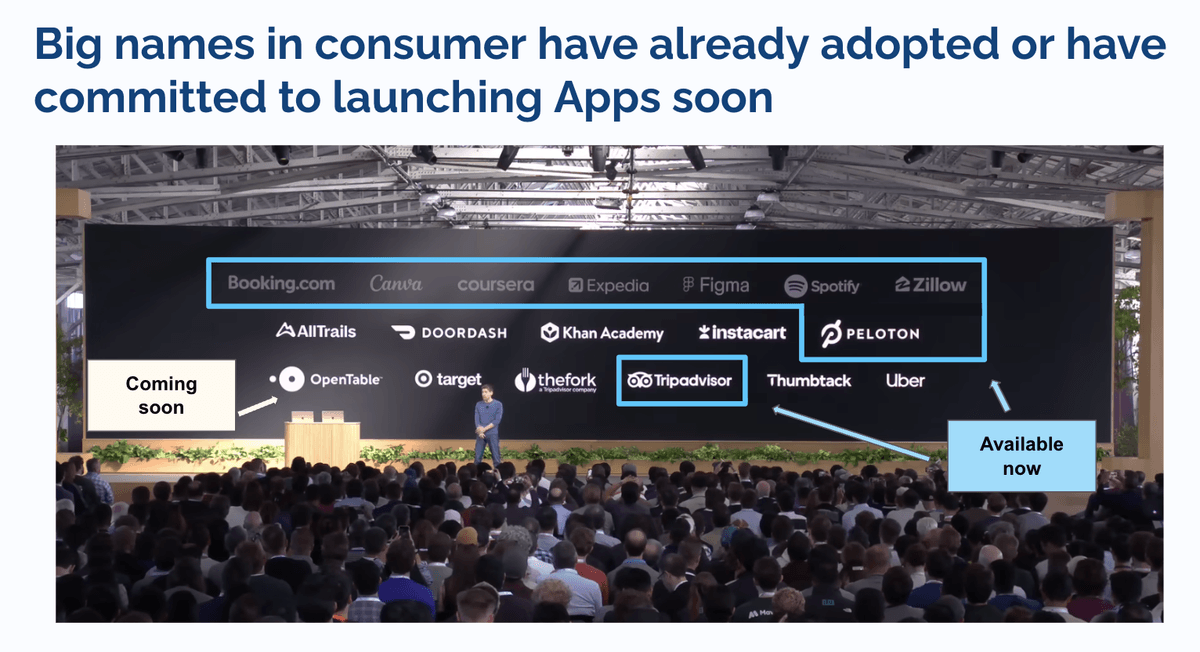
Many of them already have apps that are live in ChatGPT today for U.S.-based users.
Not Just ChatGPT
This opportunity isn’t exclusive to OpenAI. Because the Apps SDK is built on open-source technology (the Model Context Protocol), any ChatGPT App can easily be ported to other AI tools like Claude or Gemini once those companies also add UI support for Apps/Connectors.
While I’m admittedly surprised that Anthropic/Claude hasn’t done this yet, I still believe it will likely happen soon, particuarly once the OpenAI App Store formally launches later this year.
What You Have to Believe
For this to be a big deal, you have to believe a few things:
- Apps-in-Chat (e.g., OpenAI Apps) will beat AI-over-browser (e.g., Atlas).: Both connect AI to real-world data, but only one will be the ‘dominant design’. I personally lean toward believing the winner will be Apps-in-Chat: the web isn’t built for agents, and AI browsers have higher security and latency issues. That said, multiple companies are investing heavily in AI browsers, and they’re improving fast. Another wildcard might be a wearable of some sort becoming the primary format, where there’s no UI at all.
- Consumers will actually use ChatGPT Apps. Some app stores never take off: see Alexa Skills or Custom GPTs. Connectors have been well-received but slow to scale. I think utility will drive adoption here, but it’ll take time. If consumers engage at scale, others (like Claude or Gemini) will quickly follow OpenAI’s lead.
- Companies will commit to this new surface. Marketplaces and SEO-driven platforms have been the early adopters to ChatGPT Apps because they see it as a new distribution channel.Companies with proprietary data, like Airbnb, are understandably more cautious. But if user adoption grows, no one can afford to ignore where consumers engage.
If You Believe
If you believe this will be the dominant format (which I do), this is an enormous opportunity. As we covered above, the App Store does $1T of billings annually. This could entirely re-invent the application layer and app discovery itself, ushering in something like the early days of Google Search.
Companies already spend heavily on “GEO” (Generative Engine Optimization) to influence AI Search. But, GEO is a black box and is very hard to inflect. The better route may be building the right tools for the task and optimizing your App so ChatGPT suggests it.
For companies, that creates both risk and opportunity. If you’re not represented in the new AI App ecosystem, you’ll be invisible. But if you are, and you can optimize your app for discovery, the top-of-funnel potential is massive. Even gated products (like Figma or Peloton) benefit from exposure; the user might hit a paywall, but they’ve already gotten a taste of what your product can do.
Wrapping Up
I’m genuinely excited about AI Apps and think they’re a huge untapped opportunity.
I’m currently building both a ChatGPT App for NYCRSVPs, my tool for tracking NYC restaurant reservation openings, and tools for marketers like me to help optimize their ChatGPT Apps for in-chat discovery and suggestion.
If that sounds interesting, or if you’re building or marketing an App and want to compare notes, please reach out!